

Back with more to write as this will be the 3rd entry out of 5 for day 6 in Tokyo. After a long walk out from Meiji Shrine, we head back to the JR Yamanote to take a ride to our next destination. Getting to Ueno will take about 40 minutes travelling from Harajuku. It is located on the other side of town.
 Ueno (上野) is a district in Tokyo's Taitō Ward, home to Tokyo's finest cultural sites which holds the Tokyo National Museum, the National Museum of Western Art, National Science Museum and a major concert hall used by famed Japanese artists for the concert tour. It also holds the Ueno Zoo, a large numbers of Shinto Shrines and also a black market which I will be revealing more on the next blog post. Ueno is in the historical Shitamachi, literally "down-town" district of Japan, a working class area rather than where the aristocrats and rich merchants lived. Entirely lacking in high-rise condos or whiz-bang shopping malls, by Tokyo standards it's distinctly downmarket, but that means that eating, shopping and drinking are all affordably priced.

 Ueno Park (上野公園) was our first destination as we stepped out from the train station. Just across the street from the station, surely you can't miss the park as hordes of people are heading that way. Covering approximately 534 000 square meters, this place hosts the zoo, the shrines and also the museums that was mentioned earlier. Ueno Park is famous during this time of the year as hordes of school children are on their school trip and visitng the park is something not to be missed... that's what I was being told by my dad.
 The bronze statue of Prince Komatsu Akihito are being displayed here in Ueno Park. He's the seventh son of Prince Fushimi Kuniye, a member of the Fushimi-no-miya one of the shinnōke branches of the Imperial Family of Japan. He passed away at the age of 58 on the 18th January, 1903.
 Ueno Park is not all about the school children, families will also be here to witness the Cherry Blossom during the full bloom week which took place 2 weeks before my arrival into Tokyo. When I got to Ueno Park, the stuff that I saw just tree branches.

 As soon as me and my mom got to see one of the many Cherry trees that is still blossoming, we automatically went nuts about it and started to take many pictures of that ONE tree, imagine the behaviour are almost similar like a caveman who never saw what a tree looks like.

 First up was the Toshogu Shrine that was located in the heart of the Ueno Park. The name "Toshogu" is a royal title. Literally translated, Toshogu means "Light of the East" or "Sun god of the east". There are about 200 Toshogu shrines in Japan, each built to enshrine Ieyasu as a deity. The original shrine is said to have been built in 1627 by the warrior Todo Takatora, daimyo of Iga and Ise. The shrine survived the World War 2 bomb raids, massive earthquakes and even the major battles of the 1868 civil war.
 4 of the 50 large copper lanterns offered by daimyo (one of the feudal lords) during the rule of the Tokugawa Shogunate. Most of the copper lanterns are still located at the Toshogu Shrine in Nikko.

 I was largely disappointed that I didn't manage to see the real shrine as it was under construction at that time. No pictures of the shrine was taken as the shrine was covered with a picture poster of the shrine itself, making it useless for me to take the picture in the first place. I took pictures of the shrine's surroundings instead.
 The Kan'ei-ji Pagoda, or known as the Five Storied Pagoda, was built for the Tokugawa shoguns and currently stands inside the Ueno Park Zoo. The entire area was originally the grounds for the Kan'ei-ji temple which was erected to protect the Edo castle. But during the Boshin War from 1868 to 1869 the temple was destroyed while the pagoda survived.
 Ueno Park are indeed famous with it's many temples and shrines in the area. There's the Great Buddhist Pagoda which was built in 1967, replacing a buddha statue formerly stood on the site.
 The Gojo Shrine is located in the Ueno Park too. As you made your way into the temple, you'll be fascinated with it's long row of red Torii's at the entrance.

 The shrine is one of the a Shinto shrine dedicated to Inari, the God of Rice. Because rice is such an important staple of Japanese cuisine, Irani shrine are very prevalent throughout the country.


 We made it to the west side of the park where the Bentendo (弁天堂) temple is located. Now the Bentendo is a tempe dedicated to the goddess Benzaiten. The temple is located on an island in Shinobazu Pond (しのばずのいけ) . The Shinobazu Pond was not really a great sight during this time of the year as the lotus are in brownish coloured. I ended the Ueno Park tour with a prayers at the Bentendo temple and headed out to the Ueno town... which will be revealed more on my next blog post.
Ueno (上野) is a district in Tokyo's Taitō Ward, home to Tokyo's finest cultural sites which holds the Tokyo National Museum, the National Museum of Western Art, National Science Museum and a major concert hall used by famed Japanese artists for the concert tour. It also holds the Ueno Zoo, a large numbers of Shinto Shrines and also a black market which I will be revealing more on the next blog post. Ueno is in the historical Shitamachi, literally "down-town" district of Japan, a working class area rather than where the aristocrats and rich merchants lived. Entirely lacking in high-rise condos or whiz-bang shopping malls, by Tokyo standards it's distinctly downmarket, but that means that eating, shopping and drinking are all affordably priced. Ueno Park (上野公園) was our first destination as we stepped out from the train station. Just across the street from the station, surely you can't miss the park as hordes of people are heading that way. Covering approximately 534 000 square meters, this place hosts the zoo, the shrines and also the museums that was mentioned earlier. Ueno Park is famous during this time of the year as hordes of school children are on their school trip and visitng the park is something not to be missed... that's what I was being told by my dad. The bronze statue of Prince Komatsu Akihito are being displayed here in Ueno Park. He's the seventh son of Prince Fushimi Kuniye, a member of the Fushimi-no-miya one of the shinnōke branches of the Imperial Family of Japan. He passed away at the age of 58 on the 18th January, 1903. Ueno Park is not all about the school children, families will also be here to witness the Cherry Blossom during the full bloom week which took place 2 weeks before my arrival into Tokyo. When I got to Ueno Park, the stuff that I saw just tree branches. As soon as me and my mom got to see one of the many Cherry trees that is still blossoming, we automatically went nuts about it and started to take many pictures of that ONE tree, imagine the behaviour are almost similar like a caveman who never saw what a tree looks like.First up was the Toshogu Shrine that was located in the heart of the Ueno Park. The name "Toshogu" is a royal title. Literally translated, Toshogu means "Light of the East" or "Sun god of the east". There are about 200 Toshogu shrines in Japan, each built to enshrine Ieyasu as a deity. The original shrine is said to have been built in 1627 by the warrior Todo Takatora, daimyo of Iga and Ise. The shrine survived the World War 2 bomb raids, massive earthquakes and even the major battles of the 1868 civil war. 4 of the 50 large copper lanterns offered by daimyo (one of the feudal lords) during the rule of the Tokugawa Shogunate. Most of the copper lanterns are still located at the Toshogu Shrine in Nikko. I was largely disappointed that I didn't manage to see the real shrine as it was under construction at that time. No pictures of the shrine was taken as the shrine was covered with a picture poster of the shrine itself, making it useless for me to take the picture in the first place. I took pictures of the shrine's surroundings instead.The Kan'ei-ji Pagoda, or known as the Five Storied Pagoda, was built for the Tokugawa shoguns and currently stands inside the Ueno Park Zoo. The entire area was originally the grounds for the Kan'ei-ji temple which was erected to protect the Edo castle. But during the Boshin War from 1868 to 1869 the temple was destroyed while the pagoda survived.Ueno Park are indeed famous with it's many temples and shrines in the area. There's the Great Buddhist Pagoda which was built in 1967, replacing a buddha statue formerly stood on the site.The Gojo Shrine is located in the Ueno Park too. As you made your way into the temple, you'll be fascinated with it's long row of red Torii's at the entrance. The shrine is one of the a Shinto shrine dedicated to Inari, the God of Rice. Because rice is such an important staple of Japanese cuisine, Irani shrine are very prevalent throughout the country. We made it to the west side of the park where the Bentendo (弁天堂) temple is located. Now the Bentendo is a tempe dedicated to the goddess Benzaiten. The temple is located on an island in Shinobazu Pond (しのばずのいけ) . The Shinobazu Pond was not really a great sight during this time of the year as the lotus are in brownish coloured. I ended the Ueno Park tour with a prayers at the Bentendo temple and headed out to the Ueno town... which will be revealed more on my next blog post. The train stopped at the Harajuku Station (
 Instead of turning left to the Harajuku streets, we turned right to head towards the
  Meiji Shrine is a Shinto Shrine. The construction of the shrine began in 1915 and completed in November 1st, 1920. The Shrine, is build to dedicate to the deified spirits of Emperor Meiji (
 Meiji Shrine was destroyed in the World War 2's Tokyo Air Raids. It was then rebuilt through public fund raising effort and compeleted its construction in October 1958. This place is packed with tourists from around the world and normally it is flocked with tourists in the morning hours.
  The grounds consists of two areas, the Naien and the Gaien. The Naien, or the inner precinct/garden, centred on the shrine buildings, which include a treasure museum that houses articles of the Emperor Meiji and Empress Shoken. The Gaien, or the outer precinct/garden, which includes the Meiji Memorial Picture Gallery that houses a collection of 80 large murals illustrative of the events in the lives of the Emperor Meiji and his consort. It also includes a variety of sports facilities, including the National Stadium, and is seen as the center of Japanese sports. It also includes the Meiji Memorial Hall, which was originally used for governmental meetings, including discussions surrounding the drafting of the Meiji Constitution in the late 19th century.
 What we did was to visit the Naien area only, minus the treasure museum. Walking to the shrine is a long tedious walk, but with all the lush greens, great scenery and calm environment; serenaded by the chirping sound of birds and rustling leaves, taking your mind off from the busy life of Tokyo, it was all worth it.
  There were several of these Torii (
 There's also a display of Nihonshu (
 That's the main Torii before entering the Shrine.
 Before entering a Shinto Shrine, stop over the Chōzubachi (

 As I made my way to the main shrine in the center, suddenly something caught my eyes, as well as many tourists eyes. A Japanese traditional wedding. Meiji Shrine is famous for active Shinto wedding proceedings which can be seen on the inner ground of the shrine. This is an amazing sight to see with the bride in the traditional Japanese wedding kimono (
 Now the Shrine area is a huge place. The materials to make the shrine are mainly plain Japanese cypress with copper plates for the roofs. A few pictures from the outer shrine area.
 How to make your worship at the Shinto Shrine? If you watched Japanese films or Anime, probably you might have learned a few things or two from there. Make your way to the Inner Shrine. Throw your coin in to the sasenbako (
 Once done, I headed out of the inner shrine to tour about the outer shrine grounds. On the left, there's a big tree with many Ema's (
 I made my way to the Shrine giftshop to purchase a few Omamori (
 The Meiji Shrine visit took almost an hour or so as walking to the Shrine already takes a quarter of the visiting time. However, the visit to the shrine is worth it as it's one of the most beautiful shrine that Tokyo has to offer. I end my post with a few pictures taken from inside the shrine. Will blog again soon.
 A nightful of rain and a very goodnight of sleep, waking up to the sunshine of Japan gives a totally different feeling... the feeling of joy looms in.


 And also Japanese which consists of tofu, steamed vegetables, porridge, soba (
 Did I mentioned that you can name your favourite type of how your eggs to be done and the friendly
  Even the Orange juice are freshly squeezed!
 Seated next to the window near the yard, it's the best way of enjoying spring in Japan. You got to love Spring time where all the flowers bloom and the pollens are extra high in quantities too.


 With plenty of rain that came down last night, the flowers are certainly in a good mood today eh? (
 Now the cafe does sell a range of chocolates which were crafted and made by their own chefs. These chocolates aren't like any other chocolates you can buy off from the Supermarket. A piece of these babies can costs from as low as 300Yen to a high of 1500Yen a piece. Hmm, I wonder who would buy such expensive chocolates?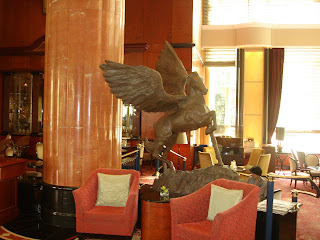

 After breakfast, we toured around the lobby area and managed to capture a few pictures of the magnificent area where it is decorated with modern european design.
 Walking out of the hotel and feeling the morning Tokyo air is another highlight as the tempreature for the day is crisp and chilly, a good day for a walk.


 The flowers bloomed beautifully around Yebisu Garden Place and the buildings surrounding the area are authentic. I'm starting to fall in love with the place. Hehe!
 As we reach the Ebisu train station, time for us to hop on the
 My first ride on the JR Yamanote line, and of course it's my very first time feeling lost too. In the train, you'll see a picture of the train line which is offered around Tokyo area. Trying to find the JR Yamanote line itself was tough, imagine trying to find other commuter lines that serves around Tokyo? If you are new to Tokyo, you'll definitely get lost on the rail.